
When a Peoria air conditioner dies catastrophically during Arizona summer, the conversation shifts fast from repair to replacement. A 4-ton compressor that seizes in the middle of a July afternoon with 113 degrees outside is not a weekend-scheduled installation scenario. A 15-year-old system running on R-410A refrigerant that throws a compressor or loses full charge through an evaporator leak rarely justifies the $2,500 to $3,500 component repair when a complete replacement with current-generation R-454B or R-32 equipment recovers the federal tax credit, eliminates the next three failures queued up behind the first one, and restores cooling to the home under a manufacturer-backed warranty rather than a 90-day parts-only patch. Emergency AC installation in Peoria AZ is the specific response to that moment.
Grand Canyon Home Services provides emergency AC installation and full system replacement across Peoria, Maricopa County, and the broader Greater Phoenix metro from the headquarters at 14050 N 83rd Ave Suite 290-220, Peoria, AZ 85381. Arizona ROC Licensed. BBB Accredited. NATE-Certified technicians on every crew. EPA Section 608 refrigerant certification for A2L refrigerant handling that the 2026 R-454B and R-32 transition now requires. Free in-home consultation. Financing available. 24/7 dispatch every day of the year, with completed installations routinely scheduled inside 24 to 72 hours from confirmed order for standard Peoria residential system replacements.
Five specific scenarios move a Peoria homeowner from repair mode to emergency installation mode during Arizona summer. Each one reflects a different failure profile, and each one changes the economics of continuing to repair versus replacing the full system.
The first is catastrophic compressor failure on a system over 10 years old. Compressor replacement on a typical Peoria residential unit runs $1,800 to $3,500 including refrigerant recovery, line set flush, filter drier replacement, brazed refrigerant connections, evacuation, and altitude-adjusted recharge. On a 12 or 14 year old system, that repair cost commits the homeowner to aging equipment with the remaining components on the back half of their service curve. On a system still under manufacturer warranty the repair economics hold. Outside warranty the replacement conversation usually wins.
The second is total refrigerant loss through an unrepairable evaporator coil leak. Evaporator coil replacement on a Peoria residential system runs $2,200 to $4,000 once access, brazing, recovery, and recharge costs are combined, and the replacement coil often comes with a limited warranty window on older systems where matched components are no longer in production. When the leaked system also runs on R-410A, which stopped being produced for new installations on January 1, 2025 and is now in final service-only supply, the replacement coil and recharge carry an additional cost premium that compounds the decision.
The third is a system running on R-22 refrigerant. R-22 phased out of U.S. production on January 1, 2020, and current 2026 recycled R-22 supply costs 4 to 6 times what R-410A or the new R-32 and R-454B refrigerants cost per pound. An R-22 leak repair on a Peoria system that is almost certainly 18-plus years old is rarely a rational economic choice compared to replacement. Homeowners in older south Peoria zip code 85345 neighborhoods built in the 1970s and 1980s occasionally still operate R-22 systems that have never been replaced, and those systems reach catastrophic failure territory the moment any significant refrigerant loss occurs.
The fourth is chronic repeat failure. A system that has required three or more emergency AC repair visits in a single Arizona summer is signaling the end of its service life regardless of what the most recent component failure was. Capacitor, contactor, blower motor, and condenser fan motor replacements in rapid succession usually mean the remaining unrepaired components are also at the end of their wear curve, and the replacement conversation moves from "eventually" to "now" because the next failure is measured in weeks not years.
The fifth is electrical fire damage or heat exchanger cracking in dual-fuel systems. Both scenarios create safety risks that make continued operation dangerous, and both typically require full system replacement rather than component repair. Burning-smell emergency calls on older Peoria systems frequently uncover melted wire insulation, scorched control boards, or cracked heat exchangers that render the unit unsafe to restart.
R-410A refrigerant production for new residential air conditioning equipment stopped on January 1, 2025 as part of the EPA's AIM Act phase-down, and by January 1, 2026 all new AC installations across Peoria and the Greater Phoenix metro must use approved low-GWP alternatives R-32 or R-454B. R-32 carries a Global Warming Potential of 675 compared to R-410A's 2,088, roughly 70 percent less environmental impact, and requires approximately 20 percent less refrigerant charge than R-410A systems. Both new refrigerants are classified as A2L meaning mildly flammable, which requires installer certification and updated installation protocols for every Peoria AC installation completed in 2026.
Industry data estimates that 75 percent of residential AC systems currently operating in the United States are oversized, and Peoria is no exception. Properly sized AC systems should complete two to three cooling cycles per hour at 10 to 15 minutes per cycle under design-day conditions, while oversized units hit the thermostat setpoint too quickly and short-cycle through repeated startup wear, poor humidity control, and accelerated compressor failure. Arizona Zone 1 homes actually require 30 to 35 BTU per square foot of cooling capacity versus the standard 20 BTU baseline used in milder climates, which means a 2,000 square foot Peoria home typically needs 60,000 to 70,000 BTU or roughly 5 to 6 tons of nominal capacity. Homeowners who match a replacement to the old nameplate rather than running a fresh Manual J load calculation perpetuate comfort problems that a correct installation would solve permanently.
Federal Inflation Reduction Act Section 25C tax credits deliver up to $2,000 for qualifying heat pump installations at SEER2 15.2 minimum, HSPF2 8.1 minimum, and EER2 10 minimum. Qualifying central AC installations at SEER2 17.0 minimum and EER2 12.0 minimum deliver up to $600. The annual 25C aggregate cap is $3,200 and resets every January 1, which creates strategic phasing opportunities for Peoria homeowners planning HVAC plus insulation or envelope upgrades across multiple tax years. Efficiency Arizona HEAR rebates stack on top of the federal credit with up to $14,000 in point-of-sale rebates for qualifying low-to-moderate income households transitioning to high-efficiency heat pump systems, which can cover nearly the entire cost of an emergency heat pump installation for eligible Peoria families.
AC installations in Peoria operate under conditions that residential HVAC equipment manufacturers rate for but rarely see in other U.S. markets. Summer design-day outdoor temperatures across Peoria run 108 to 115 degrees Fahrenheit with 100-plus consecutive days of triple-digit highs in typical years. These conditions affect every installation decision a Peoria homeowner faces.
Equipment sizing runs different math in Arizona than in moderate climates. Arizona Zone 1 homes require approximately 30 to 35 BTU per square foot of cooling capacity versus the standard 20 BTU baseline used in milder zones. This means a 2,000 square foot Peoria home typically needs 60,000 to 70,000 BTU of cooling capacity, or roughly 5 to 6 tons of nominal equipment depending on insulation quality, window orientation, ceiling height, and internal heat loads. The math is fundamentally more aggressive than most residential installation spreadsheets assume. Industry data estimates that 75 percent of residential AC systems in operation are oversized, which creates short-cycling, poor humidity control, and accelerated component wear. A properly sized Peoria AC system should complete two to three cycles per hour at 10 to 15 minutes per cycle under design-day conditions.
Altitude matters for Peoria installations more than most homeowners realize. Vistancia and Northpointe at Vistancia homes sit at roughly 18 percent elevation above the Phoenix Valley floor, climbing into the Twin Buttes and Westwing Mountain foothills. Higher elevation produces thinner air, which modestly derates AC cooling capacity and changes refrigerant pressure-temperature relationships during installation and commissioning. A technician commissioning a new system in 85383 zip code territory reads against different subcool and superheat targets than the same equipment installed in Arrowhead Ranch at 85382 on the valley floor. Installers who default to sea-level laboratory charts instead of altitude-adjusted commissioning often leave systems undercharged or overcharged in ways that surface as comfort complaints six months after installation.
Refrigerant selection is no longer an open question for 2026 Peoria installations. R-410A production stopped on January 1, 2025 for new residential equipment. All new Peoria installations completed in 2026 use R-32 or R-454B refrigerant systems. Both are classified as A2L, meaning mildly flammable, which requires installer training and updated installation protocols compared to legacy R-410A work. Contractors without current A2L handling certification should not be installing 2026 equipment, and homeowners should verify this certification before signing an installation contract.
Peoria's residential landscape ranges from 1970s and 1980s ranch construction in south Peoria at zip 85345 to 2010s and newer custom homes in Happy Valley Estates, Trailside at Happy Valley, and Preserve at Boulder Mountain. Each archetype drives different installation decisions.
Master-planned community homes across Vistancia, Vistancia Village, Blackstone at Vistancia, Trilogy at Vistancia, and Northpointe at Vistancia typically use 2000s and 2010s construction with modern HVAC rough-ins, adequate return air sizing, and ductwork that matches the home's original cooling load specifications. Replacement installations in these homes frequently run cleaner because the existing duct system still supports the replacement equipment's airflow requirements. The tradeoff is altitude-adjusted commissioning and higher-than-average cooling load demand because the Twin Buttes elevation band pushes design-day conditions into the upper end of the Sonoran Desert equipment spec range.
1990s and 2000s tract construction across Arrowhead Ranch, Fletcher Heights, and Westbrook Village presents a different installation challenge. AC systems in these homes are now on their second or third replacement cycle, original ductwork typically has accumulated 25 to 30 years of service load, and return air sizing often fails to meet current SEER2 static pressure specifications. Emergency replacement installations in these neighborhoods frequently surface a duct modification requirement that adds $1,500 to $3,500 to the project but delivers actual efficiency performance from the new equipment rather than throttling it through undersized returns.
Older south Peoria neighborhoods in zip 85345 built during the 1970s and 1980s are the most complicated emergency replacement scenarios. Original ductwork, original electrical service, original AC pads, and sometimes original R-22 refrigerant systems all compound on the replacement conversation at once. Manual J load calculations on these homes frequently produce different tonnage recommendations than the existing equipment nameplate, and installing the wrong tonnage to match the old equipment perpetuates comfort problems that a correct installation would solve permanently. Emergency installation timelines on these homes sometimes extend to 72 or 96 hours because the ductwork, electrical, and equipment selection decisions all have to happen at once rather than sequentially.
Age-restricted active adult communities at Trilogy at Vistancia, Westbrook Village, Ventana Lakes, and Sun Air Estates add a scheduling priority layer. Emergency installation dispatch to these communities carries different urgency calibration during Arizona summer because elderly residents face significantly higher heat-related illness risk during any extended indoor temperature climb. Faster temporary cooling arrangements, including portable AC units or hotel relocation referrals, often get built into the emergency installation workflow for these households while the full replacement completes.
An emergency AC installation in Peoria runs on a specific workflow that compresses the standard 5 to 10 business day scheduled installation sequence into 24 to 72 hours from confirmed order to commissioned system. The sequence matters because missing steps creates warranty problems, permit problems, and efficiency performance problems that surface months after the installation completes.
The first phase is on-site Manual J load calculation and Manual S equipment selection. Even on emergency timelines, skipping the sizing calculation in favor of matching the existing equipment nameplate is the single most common emergency installation mistake in the Peoria market. Homes that have been remodeled, had insulation upgraded, added or removed windows, or changed occupancy patterns since the original equipment install frequently need different tonnage than the existing unit provides. An expedited on-site load calculation takes 30 to 60 minutes and prevents the oversize or undersize scenario that produces comfort complaints within the first cooling season after installation.
The second phase is equipment procurement. Grand Canyon Home Services maintains inventory of the common 2.5-ton, 3-ton, 3.5-ton, 4-ton, and 5-ton R-454B SEER2-compliant equipment that covers the majority of Peoria residential replacement scenarios. On-truck and warehouse-stocked inventory eliminates the 3 to 7 business day supply chain delay that turns a scheduled installation into an emergency installation for competitor contractors who order equipment per job.
The third phase is permit coordination with City of Peoria Building and Safety. Arizona code requires a mechanical permit for AC replacement, and permits get pulled in parallel with the physical installation work rather than blocking it on emergency timelines. Post-installation inspection happens within the standard city inspection window after commissioning completes.
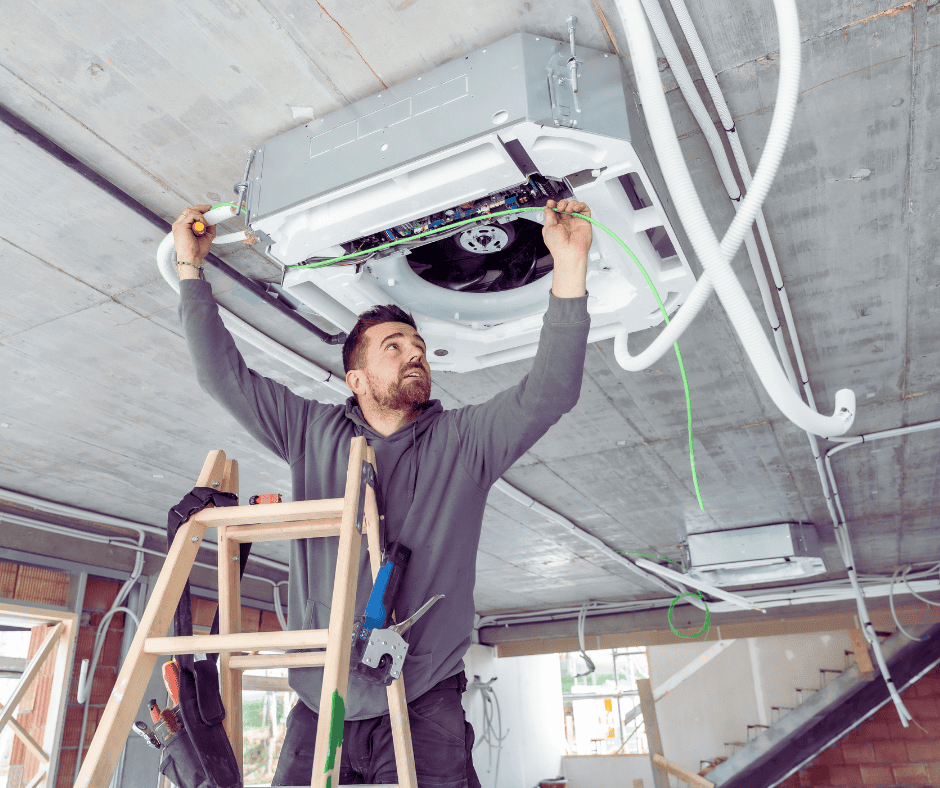
The fourth phase is the physical installation itself. Old equipment disconnect and removal, pad preparation or replacement, new condenser placement, air handler installation, refrigerant line set evaluation and flush or replacement, ductwork connection verification, electrical connection, thermostat wiring, and condensate drain routing each happen in sequence. A standard Peoria residential split system replacement takes 6 to 10 hours of active install labor once equipment is on site. Dual-system replacements or installations requiring duct modifications extend the timeline proportionally.
The fifth phase is commissioning, charge verification, and performance testing. Subcool and superheat measurement on the new installation has to be read against actual Peoria outdoor conditions and the specific altitude of the installation address rather than sea-level laboratory charts. Airflow verification at supply registers, temperature split measurement across the evaporator coil, and thermostat calibration close out the commissioning sequence. Warranty registration with the manufacturer happens on behalf of the homeowner before the install crew leaves the property.
Peoria AC replacement pricing in 2026 runs $7,000 to $17,000-plus depending on system type, efficiency tier, and installation complexity. Standard central air conditioning split systems typically fall between $7,000 and $12,000 including professional installation for SEER2 14.3 baseline equipment. High-efficiency SEER2 16 to 17 systems start around $14,000. Heat pump installations run $8,500 to $18,000 for residential capacity systems, with variable-capacity inverter systems and cold-climate-rated equipment reaching the upper end of the range. Ductless mini-split installations for single-zone or multi-zone applications run $4,500 to $15,000 depending on zone count and cassette type.
Emergency installation timelines typically add $500 to $1,500 to the total project cost versus standard scheduled installation, reflecting the dispatch coordination, inventory priority, and installer overtime that 24 to 72 hour completion requires during Arizona summer peak demand. Ductwork modifications during replacement add $1,500 to $3,500 to the project when the existing duct system fails to meet SEER2 static pressure requirements or when the home has been modified since original construction. Electrical service upgrades add $500 to $2,500 when the existing panel capacity cannot support the new equipment specifications.

The 2026 rebate and tax credit stack offsets a meaningful portion of emergency installation cost for qualifying equipment. Federal Inflation Reduction Act Section 25C tax credits deliver up to $600 for qualifying central AC replacements (SEER2 17.0 minimum and EER2 12.0 minimum) and up to $2,000 for qualifying heat pump installations (ENERGY STAR Most Efficient certification or SEER2 15.2 minimum with HSPF2 8.1 minimum and EER2 10 minimum). The annual aggregate 25C cap is $3,200 and resets January 1 each year. Efficiency Arizona HEAR rebates can provide up to $14,000 in point-of-sale rebates for qualifying low-to-moderate income households transitioning to high-efficiency heat pump systems.
Utility rebates require territory awareness specific to Peoria. Peoria sits in APS (Arizona Public Service) territory rather than SRP territory, and APS AC rebates, smart thermostat rebates, and Home Performance with ENERGY STAR Checkup rebates ended January 1, 2026 following Arizona Corporation Commission Decision No. 81584. SRP Cool Cash rebates up to $1,125 apply to SRP territory only, not Peoria APS customers. Emergency installation quotes that cite SRP rebates for Peoria homes are misapplied, and the federal 25C credit plus Efficiency Arizona HEAR represent the primary incentive stack available to Peoria homeowners in 2026.
Financing options typically cover emergency installation ticket sizes. Manufacturer-backed financing through Wells Fargo, Synchrony, and similar lenders often includes 0 percent promotional APR windows for qualifying credit profiles, with term lengths running 12 to 120 months depending on promotional structure and loan size. Emergency installation projects routinely close with financing applications submitted and approved within the same 24 to 72 hour window as the physical installation itself, which matters because a $10,000 to $15,000 cash outlay is not a realistic emergency response for most households regardless of the urgency.
Grand Canyon Home Services operates from 14050 N 83rd Ave Suite 290-220, Peoria, AZ 85381 and serves Peoria, Maricopa County, and the Greater Phoenix metro with emergency AC installation dispatch every day of the year. Service extends throughout Peoria zip codes 85345, 85381, 85382, 85383, and 85385, covering Vistancia, Vistancia Village, Blackstone at Vistancia, Trilogy at Vistancia, Northpointe at Vistancia, Westwing Mountain, Sonoran Mountain Ranch, Fletcher Heights, Arrowhead Ranch, Happy Valley Estates, Preserve at Boulder Mountain, Westbrook Village, Dove Valley Ranch, Tierra Del Rio, Terramar, Trailside at Happy Valley, Ventana Lakes, the Loop 303 corridor, Happy Valley Road corridor, and Lake Pleasant Parkway corridor. Extended service area covers Surprise, Glendale, Sun City, Sun City West, El Mirage, Litchfield Park, Goodyear, Avondale, Waddell, Wittmann, Youngtown, Tolleson, and north Phoenix. Arizona ROC Licensed. Bonded. Insured. BBB Accredited. NATE-Certified Technicians. EPA Section 608 Refrigerant Certified with A2L handling certification for R-454B and R-32 installations. Factory authorized installation on Carrier, Trane, Lennox, Rheem, Goodman, American Standard, York, Bryant, Mitsubishi Electric, Daikin, LG, and Bosch equipment. Every emergency installation includes on-site Manual J load calculation, altitude-adjusted commissioning, City of Peoria permit coordination, manufacturer warranty registration, and workmanship warranty on all installation labor. Financing available through manufacturer-backed lending partners. Free in-home consultation on all replacement projects. Call (623) 777-4779 24/7 for emergency AC installation and same-day dispatch across Peoria, Maricopa County, and the Greater Phoenix metro.
Redirect to:
|
This page is a redirect. The following categories are used to track and monitor this redirect:
|

Peoria Sports Complex in March 2008
|
|

Interactive map of Peoria Stadium
|
|
| Location | 16101 N. 83rd Avenue Peoria, AZ 85382 |
|---|---|
| Coordinates | 33°37′55″N 112°14′00″W / 33.6319°N 112.2332°W |
| Public transit | Valley Metro Bus: 83 |
| Owner | City of Peoria [1] |
| Operator | San Diego Padres Seattle Mariners |
| Capacity | 11,333 [1][2] |
| Field size | Left field: 340 ft Center field: 410 ft Right field: 340 ft |
| Surface | Grass |
| Construction | |
| Opened | 1994 |
| Construction cost | $7.7 million [1] |
| Architect | Populous |
| Tenants | |
|
|
Peoria Sports Complex is a baseball complex located in the Peoria suburb of Phoenix, Arizona, United States, near Peoria's main shopping district on Bell Road. It consists of the main baseball stadium (Peoria Stadium) and 12 practice fields. It is one of six facilities to host Arizona Fall League games. The capacity of Peoria Stadium is approximately 12,000.
During spring training, it is the home stadium of both the San Diego Padres and the Seattle Mariners, who play in the spring training Cactus League. Both teams are leased to hold spring training there until 2034.[3]
The complex has been a site of the Vans Warped Tour every summer since 2002. It is also hosts a number of other events, including youth baseball tournaments and city events.[4]
